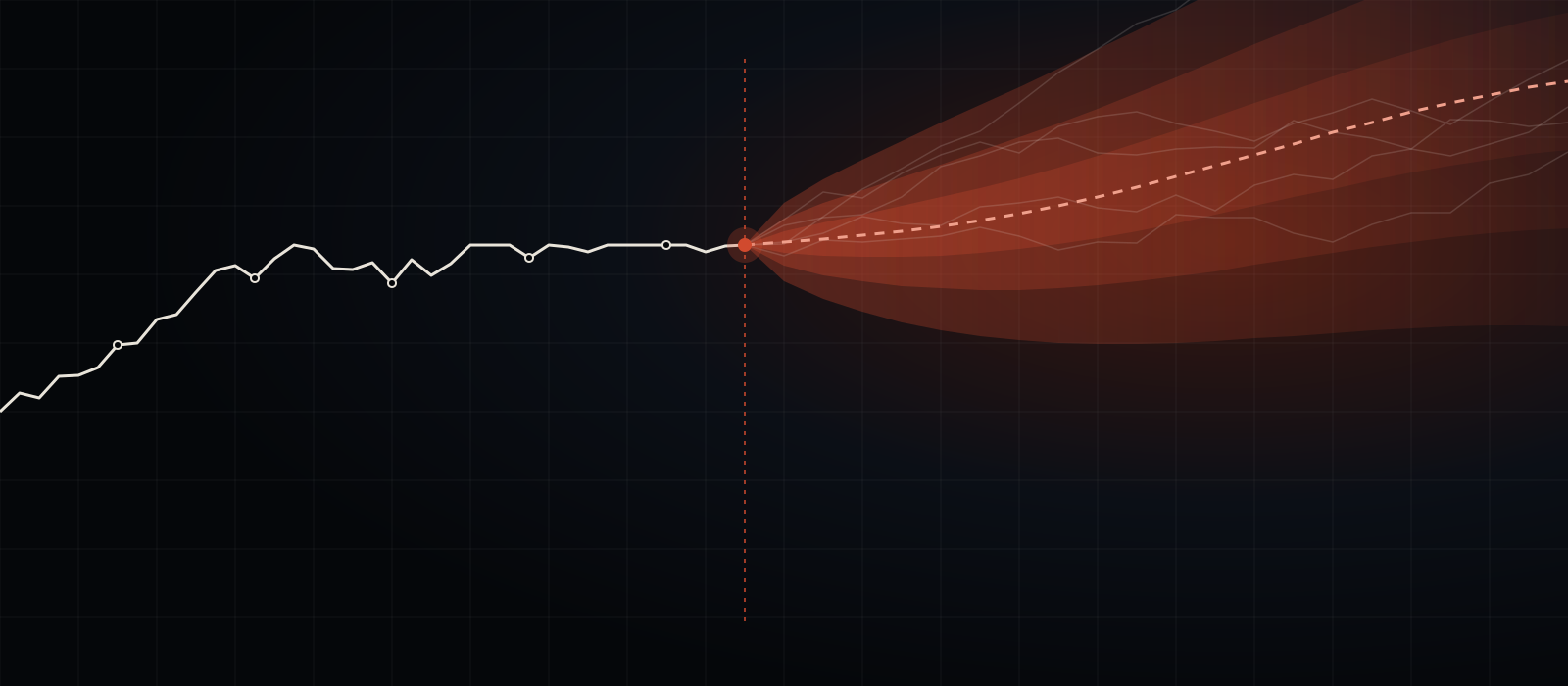
Super Intelligence (SI) is beginning to rival human superforecasters, and in one leading competition has beaten them. For financial and institutional decision-makers, the more important development is what happens when probabilistic forecasts enable continuous and auditable inputs into risk management and capital allocation.
For most of human history, forecasting has occupied the space between information, judgment and intuition. Governments and enterprises have relied on economists, intelligence agencies and domain experts. Investors have developed increasingly sophisticated models. Banks and insurers have built risk frameworks around historical data, scenario analysis and expert judgment. Boards and investment committees have made decisions using a combination of evidence, experience and conviction.
More recently, a small group of individuals known as superforecasters demonstrated that disciplined probabilistic reasoning could produce remarkably accurate predictions about uncertain events. Artificial intelligence or Super Intelligence is now beginning to challenge them.
In September 2026, The Economist, in an article titled “Artificial intelligence now beats some of the best human forecasters”, reported a significant milestone in the evolution of superforecasting. An AI system had, for the first time, won the seasonal Metaculus Cup, a forecasting competition covering questions across economics, politics, technology, public health and other fields.
The result matters because forecasting is becoming computational, continuous and operational.
If probabilities can be updated at low cost as new information arrives, they can move from the research function into the core machinery of risk management, underwriting, treasury, portfolio construction and capital allocation.
The Metaculus Contest
Hundreds of participants competed in the Metaculus contest, making probabilistic forecasts about events scheduled to resolve by September 2026. The questions were deliberately heterogeneous.
- Would an American state or a European Union country impose restrictions on data-centre development?
- Would an outbreak of hantavirus infect at least five people who were not passengers aboard the MV Hondius?
- What would the price of Brent crude oil be?
Participants were rewarded according to how close their predictions were to the eventual outcome and how long they maintained an accurate forecast.
The result was striking. AI systems finished first, second and fifth. Human superforecasters who were previously undefeated occupied third and fourth place.
This was not a specialised machine trained solely to predict oil prices, elections or disease outbreaks. These systems belonged to the same broad technological family as today’s large language models: machines capable of reading information, interpreting evidence, comparing competing explanations and producing probabilistic assessments across multiple domains.
Specialised datasets have enabled computational forecasting of weather and financial variables for decades.
What is new is a machine attempting something closer to generalised judgment under uncertainty.
Forecasting Moves Beyond the Laboratory
The economics surrounding these systems is becoming equally important.
FutureSearch, an enterprise focused on superforecasting, created a $100,000 portfolio on Kalshi, the prediction market, and used its AI to identify situations in which it believed market probabilities were incorrectly priced; by mid-September the portfolio was up about 6% since June.
One of the developers behind Preseen, whose system did not finish among the top five in the Metaculus competition, reportedly turned $35 into $1.94 million over seven months on Kalshi, producing what was described as the sixth-best return in the platform’s history.
These numbers illustrate a more important development: forecasting systems are moving from experiments about whether machines can predict events toward systems whose forecasts can be connected directly to economic decisions.
What Changed
The breakthrough does not come from a single forecasting algorithm. Instead, AI forecasting systems combine several capabilities that previously existed separately:
- They continuously read large quantities of news and research.
- They retrieve and organise data.
- They compare historical precedents.
- They identify arguments supporting opposing outcomes.
- They assign probabilities.
- And, importantly, they explain why they reached those probabilities.
That final characteristic — explainability — matters enormously when forecasting is connected directly to enterprise-level economic decisions.
A prediction without an explanation has limited institutional value.
Banks, governments, asset managers and corporate boards generally need to know not merely what a model believes, but why, based on which evidence, under which assumptions and with what degree of confidence.
That said, a model’s stated reasoning is not guaranteed to reflect how it actually arrived at a number. Explanations must themselves be tested against evidence and resolved outcomes.
The Superforecaster Benchmark
Human superforecasting itself is relatively young as an empirical discipline. A 2015 study in Perspectives on Psychological Science led by Barbara Mellers of the University of Pennsylvania examined the abilities of exceptionally accurate forecasters. Its findings illustrated just how unusual these individuals were.
Superforecasters could distinguish between events that would and would not occur roughly 300 days into the future with a level of reliability comparable to that achieved by ordinary forecasters looking only about 60 days ahead.
For years, that level of performance represented an unusually high benchmark for probabilistic judgment. But an analysis published in July 2026 by the Forecasting Research Institute, where Mellers serves as a scientific adviser, suggested that AI systems had reached approximately parity with human superforecasters on an evolving collection of forecasting questions.
The Architecture of Machine Forecasting
Better foundation models create better reasoning systems. Sophisticated forecasting platforms add layers on top of those foundation models. Several companies are working with variations of this architecture, including Solvendo, the publisher of this article, through its Limitless Quant – GeoPol platform.
The British company Mantic, for instance, supplies its AI with specialised datasets that publicly available models from companies such as OpenAI and Anthropic may not readily access because the information sits behind paywalls.
Preseen is exploring another layer of intelligence: evaluating the historical forecasting accuracy of commentators and news pundits so that the system can decide whose opinions deserve greater weight.
For institutional users, architecture matters because the system must do more than generate plausible language. It must manage evidence, provenance, uncertainty and change.
A robust forecasting architecture should be able to:
- Ingest controlled information — data sources should be identified, licensed where necessary, time-stamped and classified by reliability.
- Separate observation from interpretation — the system should distinguish verified facts from commentary, assumptions and inferred conclusions.
- Generate competing hypotheses — forecasts should not be based solely on the first coherent narrative. Alternative explanations and adverse scenarios should be actively constructed.
- Calibrate probabilities — the system should be evaluated not only on whether it is right, but on whether its stated confidence corresponds to observed outcomes.
- Track forecast revisions — institutions need to know what changed, when it changed and whether the change was driven by new evidence, model behaviour or a data-quality issue.
- Preserve an audit trail — every material forecast used in a decision should be reproducible from the information available at the time.
- Control the path to action — a forecast should not automatically trigger a trade, credit decision or capital reallocation without defined thresholds, permissions and escalation procedures.
Methodology Matters
The most interesting result from the Metaculus competition concerned the winning system itself. It was developed by Jeffrey Liang, a Texas-based, self-described polymath. According to his estimate, development required less than 150 hours of work and only a couple of thousand dollars in computing power and data.
His system defeated four startups that had collectively raised significant amounts of capital. The episode contains an important lesson about contemporary AI.
Capital matters; compute matters; data matters; but architecture, orchestration and reasoning methodology may matter just as much.
The Economics of Superforecasting Is Collapsing
Once an activity becomes computational, its marginal cost collapses. According to The Economist, a report from human superforecasters can cost more than $10,000 and take a week; FutureSearch quotes minutes and a few dollars for a machine-generated forecast.
The immediate institutional consequence is not necessarily that human analysts become redundant. It is that forecasting can be performed more frequently, across more variables and at more decision points.
Forecasting may move from being something commissioned occasionally for major decisions into something that runs continuously.
That is a fundamentally different operating model. It changes the economics of risk management for a variety of reasons. One important consequence may be a shift from periodic risk assessment to continuous risk repricing. This potential shift is a core thesis at Limitless Quant.
Solvendo’s Limitless Quant – GeoPol
For Solvendo, the significance of superforecasting is that it allows underwriting and capital allocation to rest on a computational treatment of uncertainty and the volatility associated with it.
A superforecasting system in which evidence can be organised, probabilities continuously recalculated, assumptions challenged, scenarios simulated and consequences translated into decisions is directly relevant to understanding, underwriting and hedging risk.
This is the role of Solvendo’s Limitless Quant – GeoPol platform: to help transform uncertainty from an abstract analytical problem into a structured, continuously updated input for financial decision-making.
Within the platform, the Limitless Quant engine can support the quantitative treatment of risk, exposure, recovery, volatility and scenario outcomes. The GeoPol module can support the assessment of political, regulatory, geographic and geopolitical developments that may affect assets, counterparties, supply chains and investment assumptions.
Pricing What Cannot Be Predicted
If uncertainty is reducible, institutions may invest in better data, research and monitoring. If uncertainty is structural, institutions may need to hold more capital, diversify exposure, shorten duration, purchase protection or avoid the risk altogether.
The purpose of forecasting is not to eliminate uncertainty. It is to determine which uncertainties can be reduced, which can be priced and which must be absorbed.
For centuries, human beings have tried to predict the future. Super Intelligence may finally allow institutions to do something more useful: to calculate, continuously and systematically, how uncertain the future actually is — and how much capital should be committed in response.
Source note: This article was inspired by and draws upon factual reporting contained in The Economist, “Artificial intelligence now beats some of the best human forecasters”, published 16 September 2026. The analysis, structure, interpretation and conclusions presented here are Solvendo’s. Other sources referred to: Metaculus Cup (Summer 2026) results; Forecasting Research Institute analysis (July 2026); Mellers et al., Perspectives on Psychological Science (2015).