A Panel Built on Three Vantage Points
The Bloomberg New Economy Forum came to India for the first time this October, under the theme A World in Play: Defining the New Levers of Power. Its opening plenary carried a title that would have sounded alarmist a decade ago and now reads as description: The End of Predictability.
Moderated by Bloomberg’s Erik Schatzker, the panel brought together three people who see the global economy from very different seats. Natarajan Chandrasekaran, Chairman of Tata Sons, spoke for industry — the long-horizon business of building factories, supply chains and capabilities. Jonathan Gray, President and Chief Operating Officer of Blackstone, spoke for capital — the business of deciding where trillions should be deployed. Rishi Sunak, former Prime Minister of the United Kingdom, spoke for policy — the business of governing in a world whose rules are shifting.
What was striking was not where they disagreed, but how consistently they described the same underlying condition.
Everything, All at Once
Chandrasekaran began from history. The Tata Group is more than 160 years old. It has lived through two world wars, through periods of punishing borrowing costs, through every kind of economic upheaval India has known. Disruption, in other words, is not new to it.
What is new, he argued, is that geopolitical tension, AI disruption and commodity and supply-chain crises are all happening at the same time.
This is a more important observation than it first appears. Most of the risk architecture that governs modern finance — portfolio diversification, credit provisioning, stress testing — implicitly assumes that shocks are, to some degree, independent. A war disrupts one region; a commodity spike hits one sector; a technology shift erodes one industry. Diversification works because not everything goes wrong together.
Simultaneity is the condition under which that assumption fails. When geopolitics drives commodity prices, commodity prices drive supply chains, and AI simultaneously rewrites the cost structure of entire industries, shocks stop being independent events and become a correlated system.
The danger is not any single shock. It is the correlation between them — the hidden variable that turns a diversified portfolio into a concentrated one overnight.
The Capital View: Build Through It
Gray framed the moment in terms of technology. In his view, this is an era that will be defined by artificial intelligence, and he reached for a historical parallel: the American Industrial Revolution of 1870 to 1900, when new technology profoundly changed how consumers lived, how businesses operated and how governments oversaw society. Superintelligence, deployed globally, could do the same.
But Gray was equally clear about the risks: technology-driven disruption, escalating geopolitical conflict, and what he called “the lack of fiscal sustainability in western governments.”
That last point deserves attention. For most of the post-war era, Western sovereign debt was the risk-free anchor against which everything else was priced. If sovereign balance sheets themselves become a source of instability, the reference point of global finance begins to move.
Yet Gray’s conclusion was not retreat. Blackstone, he said, intends to deploy more capital in India, focusing on electricity, digital infrastructure, defence and life sciences as AI moves into the physical world. He credited India’s progress on infrastructure, its openness to foreign investment and — notably — its improvements in dispute resolution.
That a global allocator lists dispute resolution alongside power and data centres is telling. Capital does not need certainty about outcomes. It needs confidence that when things go wrong, there is a credible, timely path to resolution.
The Policy View: Rules Give Way to Interests
Sunak supplied the geopolitical frame. The world, he argued, is moving away from the multilateral, rules-based framework that underpinned global commerce for decades. China has emerged as a peer competitor to the United States across multiple strategic domains. Hard power is becoming more significant. And countries such as India and those in the Gulf are increasingly able to pursue their own strategic interests rather than consistently aligning with either Washington or Beijing.
Of these middle powers, he observed: “They’re going to do what they want, and that’s a new feature.”
For anyone pricing risk, this is the most consequential of the three arguments. A rules-based order is, among other things, a predictability machine. It narrows the range of plausible outcomes. It makes contracts enforceable across borders and makes yesterday’s behaviour a reasonable guide to tomorrow’s. As rules give way to interests, base rates shift, historical correlations weaken, and the past becomes a less reliable teacher.
This is the multipolar world we described earlier this year in The New Delhi Moment. It is notable that the forum chose New Delhi to have this conversation.
Predictability Was Never the Asset
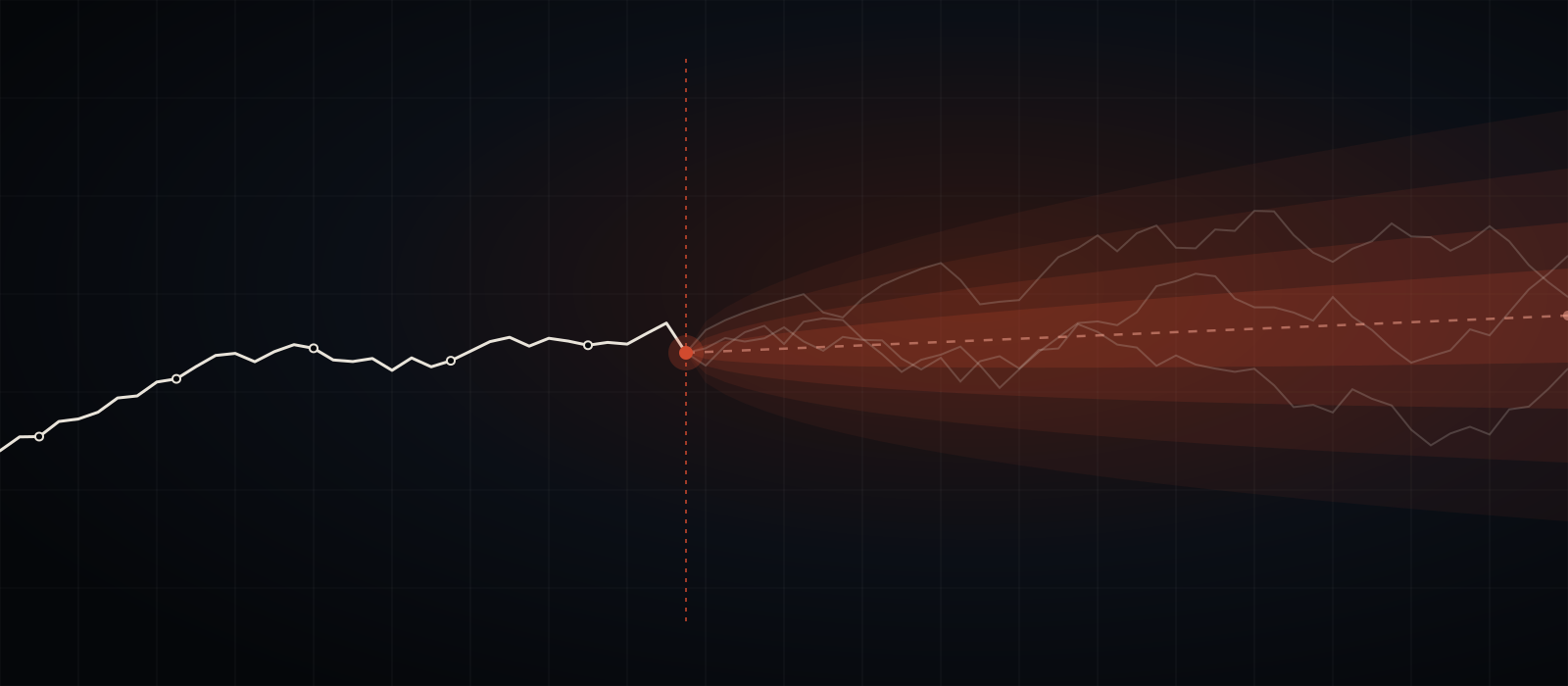
Taken together, the three perspectives point to a conclusion the panel’s title only partially captures. What has ended is not predictability itself. What has ended is the comfort of the single expected path — the point forecast, the base case, the five-year plan that assumes tomorrow will resemble today plus a trend.
The point forecast was always a simplification. It survived because, for long stretches, the world was stable, the roadmap was linear and circumstances were given that fundamentally strong constructs simplification did little harm. Infact most serious capital preferred simple and fundamentally strong bets. This changes in a world of simultaneous, correlated shocks.
The response is not to abandon forecasting, but to rethink it. The future may not be predictable, but uncertainty is better measurable than ever before. A probability of 30 per cent is not a failed prediction when the event does not happen; it is an accurate and honest one. Truth is seldom simple or binary. Considering the complexity of the coming times it is expected to be even more complicated than before. This calls for understanding and navigating the future and the risks of the future through probabilities and calibration.
The end of simplistic risk management is the beginning of calibration. Institutions that cannot forecast the future can still learn to price it.
This is the premise behind Geopol, and the argument we made in When the Future Becomes Computable: probabilistic forecasts, produced continuously and audited against outcomes, can become inputs into risk management and capital allocation in the way that credit ratings once did — but updated daily rather than annually.
Where the Loss Lands
There is a second, less discussed consequence of correlated risks in the context of credit. When shocks are simultaneous, defaults are simultaneous. And when defaults cluster, the decisive question shifts from whether losses occur to how much is recovered, and how quickly.
Finance has spent decades building sophisticated machinery for the Probability of Default. It has invested far less in the other half of the credit equation: loss given default. Recovery is still, in most markets, a slow, opaque and largely manual process. In a calm world, that inefficiency is tolerable. In a world of correlated distress, it becomes systemic — value is destroyed not only by the shock itself, but by the time it takes to resolve its consequences.
Gray’s emphasis on dispute resolution and Chandrasekaran’s insistence that resilience need not come at the expense of efficiency point to the same idea. In an unpredictable world, the ability to resolve distress quickly is not a back-office function. It is a strategic capability — for firms, for markets and for nations.
Certain About the Destination, Probabilistic About the Path
Perhaps the most instructive moment came from Chandrasekaran’s defence of Tata’s long-horizon bets, including its semiconductor programme, which he argued should not be judged on whether it meets targets in two or three years. His reasoning was simple: chips will be fundamentally required, whenever and however India comes to make them.
This is what strategy looks like after the end of predictability. Not certainty about the path, but conviction about the destination — combined with an honest, probabilistic view of everything in between. The institutions that endure will be those that hold both at once: a long-term thesis grounded in first principles, and a risk apparatus that measures, prices and resolves uncertainty continuously rather than pretending it away.
In a world that no longer follows a single path, the advantage belongs to those who can think in probabilities and act on them.
The views expressed are those of the author. Quotations and positions attributed to the panellists are drawn from the session and its contemporaneous press coverage.